
How to Make Sourdough Bread with Stone-Milled Flour
To make sourdough bread with stone-milled flour, mix 500 g stone-milled flour with 380 g water, 100 g active starter and 11 g salt. Rest 45 minutes, then bulk-ferment 4–5 hours with four sets of folds. Shape, cold-proof overnight, and bake in a covered pot at 250 °C, then uncovered at 220 °C.
at a glance
| Flour | Lowerland Estate Blend (stone-milled, non-GMO) |
| Hydration | 76% |
| Hands-on time | 40 minutes |
| Total time | 24 hours (mostly unattended) |
| Yield | One 900 g loaf |
| Difficulty | Intermediate — no kneading, but timing matters |
| Equipment | Scale, mixing bowl, banneton or lined bowl, cast-iron pot with lid |
why stone-milled flour behaves differently
Roller-milled white flour is stripped of the germ and bran, then aged and often bleached. Stone milling crushes the whole grain slowly between stones and keeps the germ oil and bran in the flour. That changes three things you can feel in the dough:
- It drinks more water. Bran is thirsty. The same recipe made with supermarket white flour at 76% hydration would feel soupy; here it feels merely slack.
- It ferments faster. The bran and germ carry more of the grain’s own enzymes and wild yeast food, so bulk fermentation runs shorter than a white-flour recipe suggests. Watch the dough, not the clock.
- It has a shelf life. The germ oil goes rancid over months. Keep your flour sealed and cool, and buy it in quantities you’ll use within about three months.
Lowerland grain is grown on the banks of the Orange River outside Prieska and milled on the farm. It is non-GMO, unbleached and unenriched — flour and nothing else.
Shop: Lowerland Estate Blend · Kalahari White Wheat · Hard Red Wheat
before you start: your starter
You need an active starter — one that has been fed, has doubled, and is domed rather than collapsed. Feed it 8–12 hours before you mix.
Don’t have one? Lowerland sends a dried sourdough starter free with any flour order. Rehydrate it with equal parts flour and lukewarm water and feed daily for about five days until it doubles reliably.
The float test: drop a teaspoon of starter into water. If it floats, it’s ready. If it sinks, feed it and wait.
ingredients
| Ingredient | Weight | Baker’s % |
|---|---|---|
| Lowerland Estate Blend flour | 500 g | 100% |
| Water, 28 °C | 380 g | 76% |
| Active sourdough starter | 100 g | 20% |
| Fine salt | 11 g | 2.2% |
Weigh everything. Cup measures and stone-milled flour do not get along — the bran makes the flour pack unevenly, and a 15% error in flour will wreck the loaf.
method
1. autolyse — 45 minutes
Mix the flour and water until no dry flour remains. No kneading. Cover and rest 45 minutes. The flour hydrates fully and the gluten starts organising itself without any work from you.
2. add starter and salt — 10 minutes
Add the starter and salt. Squeeze and fold the dough through your fingers until fully incorporated — about two minutes. It will look shaggy and torn. That’s correct.
3. bulk ferment — 4 to 5 hours at 24–26 °C
Do four sets of stretch-and-folds, 30 minutes apart, during the first two hours. Reach under one side of the dough, stretch it up, fold it over the top. Rotate the bowl and repeat four times.
After the folds, leave it alone. The dough is ready when it has risen roughly 50%, feels domed and airy, and shows bubbles at the edges.
Prieska note. In a Northern Cape summer kitchen at 32 °C this stage can finish in under three hours. In winter it may take seven. Judge by the dough’s rise and feel, not by the clock.
4. pre-shape and bench rest — 30 minutes
Tip the dough onto a lightly floured counter. Fold the edges to the centre, flip seam-side down, and drag it in a circle to build surface tension. Rest uncovered 20–30 minutes.
5. shape — 5 minutes
Flip the dough over. Fold the sides in, then roll it up from the bottom into a tight parcel. Place seam-side up in a floured banneton or a bowl lined with a floured tea towel.
6. cold proof — 12 to 16 hours
Cover and refrigerate overnight. The cold slows the yeast but not the acid-producing bacteria, which is where the flavour comes from. It also firms the dough so it scores cleanly.
7. bake — 45 minutes
Put your cast-iron pot with its lid in the oven and heat to 250 °C for at least 30 minutes.
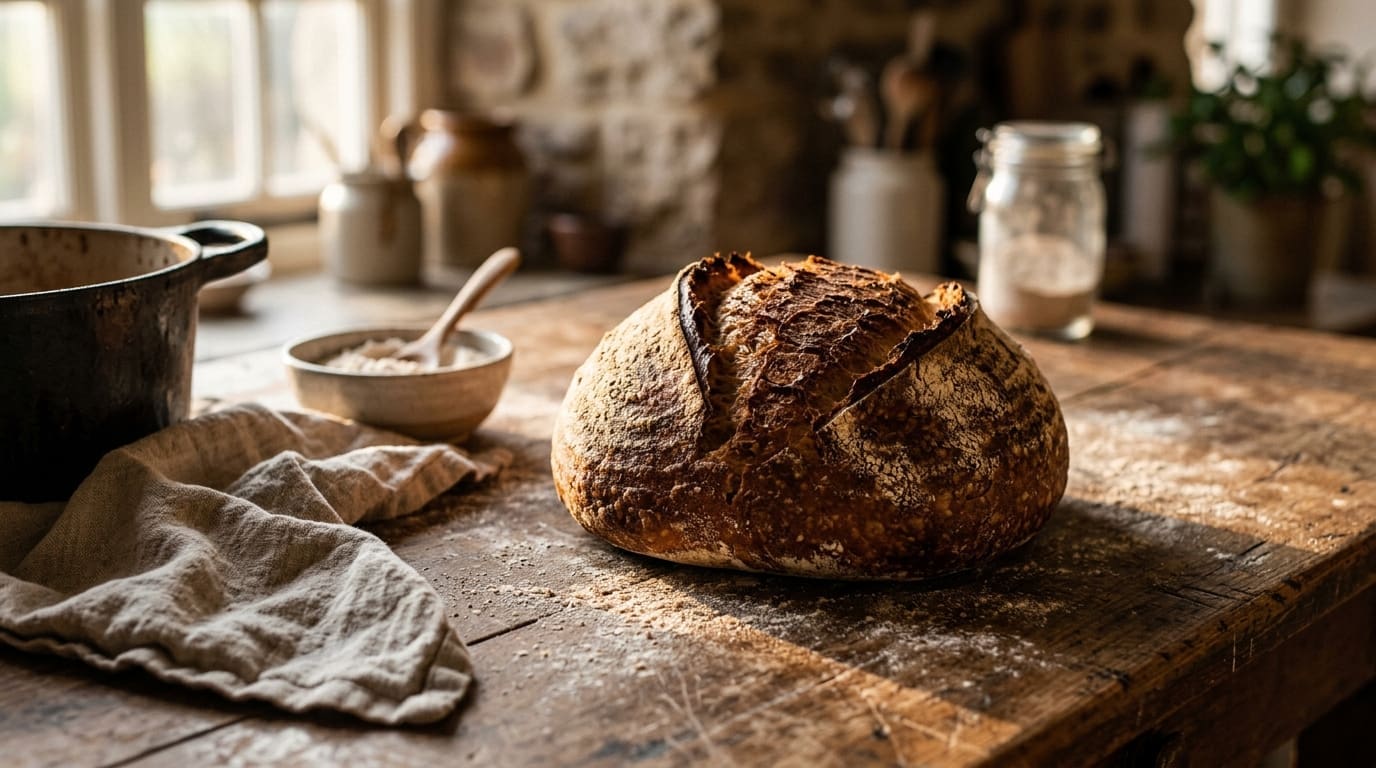
Turn the cold dough out onto baking paper. Slash the top 1 cm deep with a blade at a shallow angle. Lower it into the hot pot, lid on.
- 20 minutes at 250 °C, lid on. The trapped steam keeps the crust soft so the loaf can spring.
- 20–25 minutes at 220 °C, lid off. Deep brown crust.
The loaf is done at an internal temperature of 96–98 °C. Cool on a rack for at least two hours before cutting — the crumb is still setting, and cutting hot bread makes it gummy.
troubleshooting
| What you see | What happened | Fix next time |
|---|---|---|
| Dense, tight crumb | Under-fermented, or a sluggish starter | Extend bulk; feed the starter twice before baking |
| Flat, spreading loaf | Over-fermented, or shaped too loosely | Shorten bulk; build more tension at shaping |
| Crust tears at the side | Under-scored | Slash deeper — 1 cm, one confident cut |
| Gummy centre | Cut too soon, or underbaked | Bake to 96 °C internal; cool 2 hours |
| Dough is unworkably sticky | Normal for stone-milled at 76% | Wet your hands instead of adding flour |
| Sour, alcoholic smell | Over-fermented | Reduce bulk time or use a cooler spot |
frequently asked questions
Can I use stone-milled flour in a recipe written for white bread flour?
Yes, but add roughly 5% more water and expect fermentation to run about 20% faster. Start by substituting half the flour if you want a gentler transition.
Does stone-milled flour need sifting?
No. The bran is part of the point. If you want a lighter crumb, sift out the coarsest bran and keep it for porridge.
How do I store the flour?
Sealed, cool and dark. The germ oil means stone-milled flour keeps months, not years. Refrigerate or freeze if you buy in bulk.
Can I bake this without a cast-iron pot?
Yes. Bake on a preheated tray with a metal pan of boiling water on the shelf below for the first 20 minutes, then remove the pan.
Is Lowerland flour non-GMO?
Yes. It is grown on the farm from non-GMO seed, stone-milled on site, and sold unbleached and unenriched.
what to bake with next?
- Raw Honey — on the first warm slice
- Beef Tallow — for frying the second-day bread
- River Rye — swap in 20% for a darker, earthier loaf
- Lowerland sourdough bread — if you’d rather we baked it