
How to Make Sourdough Hamburger Buns with Stone-Milled Flour
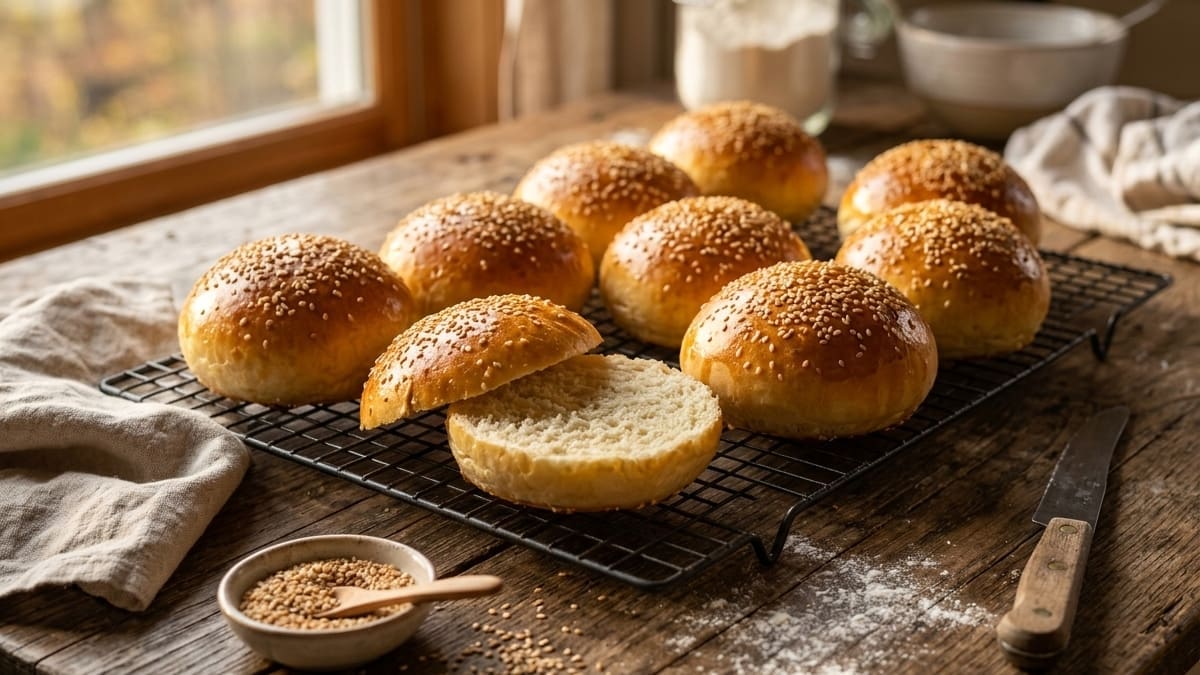
To make sourdough hamburger buns, mix 500 g stone-milled flour with 250 g milk, 100 g active starter, one egg, 50 g softened butter, 40 g honey and 10 g salt. Bulk-ferment 4–5 hours, divide into eight 120 g pieces, shape into balls, proof 2–3 hours, then bake at 190 °C for 18–20 minutes.
at a glance
| Flour | Kalahari White Wheat (stone-milled, non-GMO) |
| Enrichment | Milk, egg, butter, honey |
| Hands-on time | 45 minutes |
| Total time | 8 hours, or overnight with a cold proof |
| Yield | 8 buns, about 110 g baked |
| Difficulty | Beginner-friendly — enriched dough is forgiving |
| Equipment | Scale, mixing bowl, baking tray, pastry brush |
why an enriched dough, and why stone-milled
A burger bun has one job the crusty loaf doesn’t: hold a hot, wet patty together without going to pieces or fighting back when you bite. That means soft, not chewy — and a thin crust, not a crackling one.
The fat and sugar do that work. Butter and egg shorten the gluten strands so the crumb tears softly. Milk and honey feed browning, which is why enriched buns colour at 190 °C where a lean loaf needs 230 °C.
Stone-milled flour brings flavour the roller-milled version can’t. Kalahari White Wheat is the right pick here — it’s the mildest of the Lowerland grains, so the wheat flavour supports the meat instead of arguing with it. Use the Estate Blend if you want the buns to taste more assertively of grain.
Shop: Kalahari White Wheat · Lowerland Estate Blend · Raw Honey
before you start: your starter
Feed your starter 8–12 hours ahead. It should be domed and doubled when you mix — enriched dough ferments slowly, because fat coats the flour and slows water uptake, so a weak starter will simply stall.
No starter? Lowerland includes a dried sourdough starter free with any flour order.
ingredients
| Ingredient | Weight | Baker’s % |
|---|---|---|
| Kalahari White Wheat flour | 500 g | 100% |
| Full-cream milk, lukewarm | 250 g | 50% |
| Active sourdough starter | 100 g | 20% |
| Egg (1 large), plus 1 for washing | 50 g | 10% |
| Butter, soft | 50 g | 10% |
| Raw honey | 40 g | 8% |
| Fine salt | 10 g | 2% |
| Sesame seeds, optional | — | — |
method
1. mix — 15 minutes
Combine flour, milk, starter, egg and honey. Mix to a rough dough, then rest 30 minutes.
Add the salt and work it in. Now add the soft butter a third at a time, squeezing it through the dough until each addition disappears before adding the next. The dough will break apart and look wrong. Keep going — it comes back together.
Knead 5–8 minutes until smooth and slightly tacky.
2. bulk ferment — 4 to 5 hours at 24–26 °C
Two sets of stretch-and-folds in the first hour, then leave it. The dough is ready when it has risen about 50% and feels pillowy.
Prieska note. Enriched dough runs slower than lean dough, but a 32 °C kitchen still moves fast — and warm butter makes the dough greasy and hard to shape. If your kitchen is above 28 °C, ferment in the coolest room you have.
3. divide and shape — 20 minutes
Turn out the dough and divide into 8 pieces of about 120 g each. Weigh them; unequal buns bake unevenly.
Shape each into a tight ball: flatten lightly, fold the edges to the centre, flip seam-side down, and roll under a cupped hand against the counter until the surface is smooth and taut.
Place on a lined tray, well spaced. Flatten each ball gently with your palm to about 2 cm high — buns rise up, and unflattened balls bake into domes that won’t take a patty.
4. final proof — 2 to 3 hours
Cover loosely and proof until visibly puffed and slow to spring back when poked. Or refrigerate overnight, 8–12 hours, and bake straight from cold — the flavour is better and the timing is easier.
5. bake — 20 minutes
Heat the oven to 190 °C.
Beat the second egg with a splash of milk and brush the tops. Scatter sesame seeds if you’re using them.
Bake 18–20 minutes until deep golden. Internal temperature should be 92 °C. Cool on a rack — at least 30 minutes, or the steam trapped inside will make them soggy.
troubleshooting
| What you see | What happened | Fix next time |
|---|---|---|
| Buns domed, no flat top | Not flattened before proofing | Press to 2 cm before the final proof |
| Dense, heavy crumb | Under-proofed, or a sluggish starter | Extend the final proof; feed the starter twice |
| Buns spread flat | Over-proofed, or shaped too loosely | Shorten the proof; roll tighter balls |
| Pale tops | Oven too cool, or no egg wash | Wash properly; check oven with a thermometer |
| Greasy, unmanageable dough | Butter added too fast, or kitchen too warm | Add butter in thirds; work somewhere cooler |
| Buns collapse on cooling | Overbaked at too high a heat | 190 °C, and bake to 92 °C internal |
frequently asked questions
Can I make these with commercial yeast instead?
Yes. Replace the starter with 7 g instant yeast and add 50 g extra flour and 50 g extra milk. Bulk ferment becomes about 90 minutes and the final proof about 45 — but you lose the sourdough flavour and the keeping quality.
How long do they keep?
Two days at room temperature in a paper bag. They freeze well sliced — toast straight from frozen.
Can I make them bigger?
Divide into 6 pieces of 160 g for a large burger bun, and add 3–4 minutes to the bake.
Why is my dough so much stickier than a videos I watch on Youtube?
Stone-milled flour holds water differently, and enriched dough is tacky by nature. Resist adding flour — you’ll get dry, dense buns. Wet or oil your hands instead.
Is Lowerland flour non-GMO?
Yes. Grown on the farm from non-GMO seed, stone-milled on site, sold unbleached and unenriched.
what goes in them?
- Beef Patties — grass-fed, from the Lowerland Reds herd
- Pork Patties — for something sweeter under the pickle
- Lowerlander Boerewors — coiled flat, it fits a bun perfectly
- Fresh Pastured Eggs — for the wash, and for the fried egg on top