
Regenerative farming means farming so that the land is measurably better afterwards than it was before — more living soil, more plant and animal diversity, more water held in the ground. At Lowerland, on the banks of the Orange River between Prieska and Niekerkshoop, that translates into five things: perennial crops wherever they will grow, mixed herds moved daily on holistic grazing, breeding animals suited to this place rather than to a catalogue, nutrient loops closed on the farm, and no synthetic fertiliser or chemical control.
the short answer
“Regenerative” is not a certification and it is not a marketing word we borrowed. It is a test: does the system rebuild what it uses? Conventional farming asks how much can be extracted this season. Organic farming asks what may not be applied. Regenerative farming asks a harder question — is the soil deeper, the veld thicker and the farm more resilient at the end of the year than at the start?
On our farm the practices that answer that question are:
- Crop rotations, interplanting, relay cropping and no-till planting
- High-density holistic grazing with mixed herds of grazing animals
- Breeding programmes selecting for fertility, adaptability, disease resistance and resilience
- Closed-loop, integrated production systems
- Cover crops and manure to build fertility, instead of bought-in inputs
- Minimal intervention: zero synthetic fertiliser, zero chemical control measures
- Organic certification of crops, eggs and on-farm manufacturing
Everything below is the reasoning behind that list.
the Northern Cape does not let you cheat
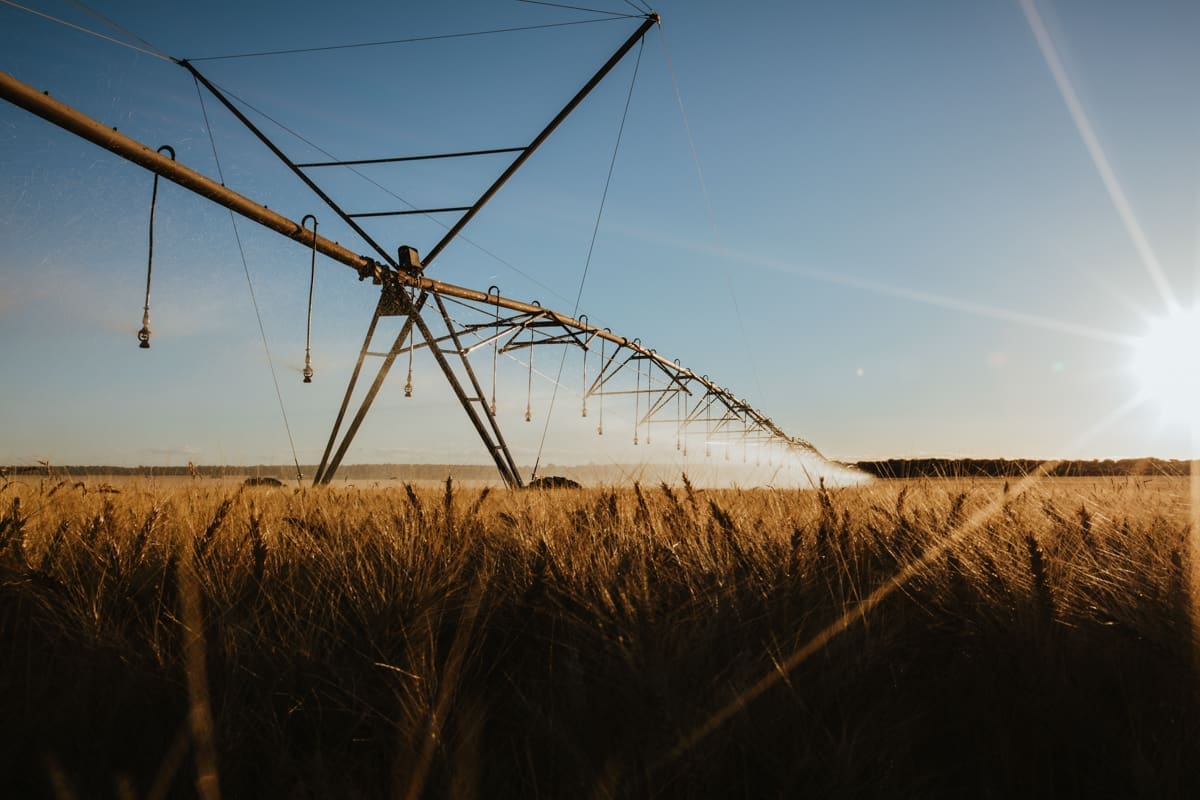
Lowerland sits where the Bo-Karoo runs out against the dunes, on a ribbon of irrigated land beside the Orange River. It is hot, dry and bright. Rain is an event, not a season. Soils here are sandy and low in organic matter, which means they hold very little water and lose what they are given.
That is the whole argument for regenerative practice in one sentence: in a place this marginal, the difference between soil that holds water and soil that does not is the difference between a crop and a failure. Organic matter is the cheapest water storage available to us. Every practice on the list above exists to build it, keep it covered, and stop it blowing or washing away.
In a high-rainfall region you can farm badly for a long time before the land tells you. Here it tells you inside two seasons.
perennials first
Annual crops are re-planted every year, which means the soil is opened up every year. Perennial species — trees, vines, long-lived pastures — keep living roots in the ground continuously. Living roots feed soil biology; soil biology builds structure; structure holds water. A perennial block also carries its own micro-climate, shades its own soil surface and supports insects and birds that an annual field cannot.
So we lead with perennials wherever a perennial will do the job, and use annuals in rotation around them. Where we do plant annuals, we plant into cover rather than into bare ground, and we relay one crop into the standing previous crop so the soil is never left naked under a Karoo sun.
animals are a farming tool, not just a product
Our herds are mixed, and they are moved. High-density holistic grazing means a large group of animals grazes a small area for a short time and then leaves it alone for a long time. The short, intense visit does three useful things: it grazes the palatable and unpalatable plants together instead of letting the herd pick out only the sweet species, it presses seed and litter into the soil surface with hoof action, and it deposits manure and urine evenly across the block rather than in the same shaded corner every day.
The long rest afterwards is where the recovery happens. Plants re-grow from full reserves instead of being nibbled back the moment they show green, which is what kills veld over time.
Different species graze differently, so a mixed herd covers more of the plant community and breaks parasite cycles that build up under single-species grazing. The meat is a consequence of running the animals well. It is not the reason they are there.
breeding for this place
An animal that needs shade, supplements and regular treatment to stay alive on the Orange River is an animal that will cost the system more than it returns. We select for fertility, adaptability, disease resistance and resilience — the traits that let an animal raise young on what the veld actually offers, in the heat that is actually here.
It is a slower way to build a herd than buying in high-performance genetics. It is also the only version that stays standing without a chemical support system behind it.
closing the loop
A closed-loop farm tries to generate its own fertility rather than import it. Manure from the herds goes back to the lands. Cover crops fix nitrogen and feed soil life between cash crops. Crop residues feed animals; animals feed the soil; the soil feeds the next crop. Milling, curing and other on-farm manufacturing keep the value — and the by-products — on the farm instead of exporting both.
The practical result is that we do not use synthetic fertiliser or chemical control measures at all, and our crops, eggs and on-farm manufacturing are certified organic. Certification is the floor, not the ceiling: it verifies what we leave out, while the regenerative work is about what we build.
soil to soul, veld to fork, nose to tail
The three phrases we farm by each carry an obligation.
Soil to soul means the chain from the ground to the person eating is one chain, not two industries. Veld to fork means we sell direct to you rather than through a series of middlemen, which is how food grown this way stays affordable enough to be worth growing this way. Nose to tail means when an animal is harvested, the whole animal is used and sold — not only the four cuts a supermarket finds convenient. A farm that only sells prime cuts has to raise far more animals for the same income.
That is also why our product range looks the way it does. The basket of flour, grains, meat, nuts and wine is not a merchandising decision — it is what a diverse, regenerating system produces when you let it be diverse.
what regenerative farming is not
It is not a finished state. There is no point at which a farm is declared regenerative and stops. It is not the same as organic — a farm can be certified organic and still degrade its soil, and a farm can build soil beautifully without ever certifying. And it is not effortless or automatically cheaper; it trades bought inputs for observation, planning and labour.
What it does buy is a farm that gets steadier rather than more fragile, and food with something behind it.
common questions
Is regenerative the same as organic?
No. Organic is a certified standard defining what may not be used. Regenerative describes an outcome — soil, biodiversity and water-holding capacity improving over time. Lowerland is both: certified organic on crops, eggs and on-farm manufacturing, and regenerative in how the whole system is designed.
Does grazing animals harm the land?
Continuous, unmanaged grazing does. Grazing managed for density and rest builds it. The variable is not whether animals are present but how long they stay and how long the plants get to recover.
Why buy directly from the farm?
Selling direct is what makes food grown this way affordable. It also means you can ask exactly where something came from and get a real answer. We courier anywhere in South Africa.